

Reuse is part of a virtuous circular economy. It reduces the amount of single-use packaging and, above all, the resulting waste pollution.
What is reuse? Why reuse and what are its applications? What are the concrete impacts of packaging reuse for industrial and foodservice players?
Definition
Reuse vs. reutilization and recycling
Reuse
Reuse
Recycling
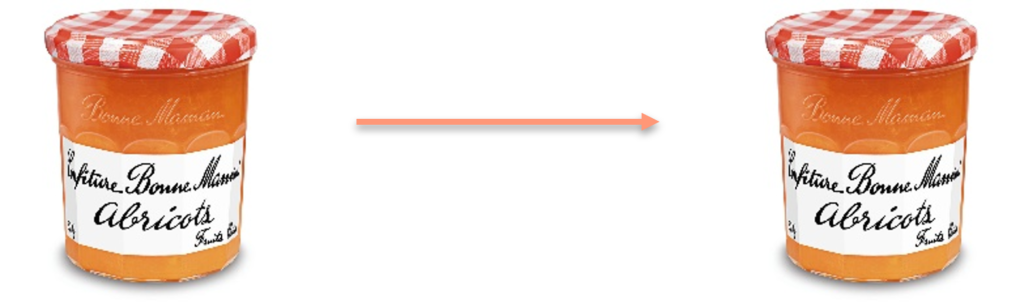

A re-used container retains its original function, for which it was created.
A jam jar is about to be filled once again with jam.
A container is reused when it retains its original form but not its function.
A jam jar can be reused as a button box for sewing.
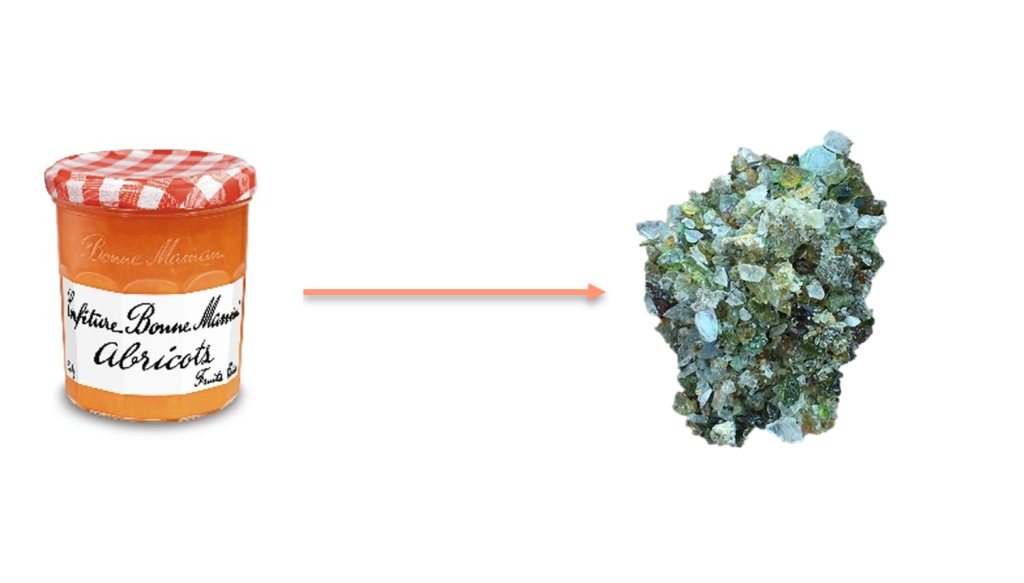
The container is destroyed. Its material is recycled to create another object, whatever its function.
For example, a jam jar is recycled when it is crushed and the glass used to make another glass object.
Market
Reuse in France
Breaking out of the disposable logic
Every year, over 5 million tonnes of single-use household packaging are put on the market (source ADEME). Food packaging accounts for 80% of this tonnage, of which 800,000 tonnes is generated by out-of-home consumption, with fast-food restaurants in the lead (source ADEME). Overall, the waste sector currently accounts for 4% of greenhouse gas emissions. emissions (source ADEME).
Given the urgency of the situation, reuse is an appropriate response to the need to eliminate disposable packaging. Moreover, the hierarchy of waste treatment methods, which forms the legal basis of waste management, places reuse as the 3rd pillar of the hierarchy of waste treatment methods, ahead of recycling.
Back to the deposit era
Packaging reuse was abandoned in the 80s in favor of single use (source Zero Waste France). Single-use packaging, and in particular plastic packaging, came to the fore for its low cost and technical practicality, against a backdrop of the advent of mass retailing.
However, reuse has persisted in the café-hotel-restaurant sector, where 30 to 40% of used bottles are still returned for washing and refilling, as are stainless steel beer kegs. The system has also endured in Alsace , where 25 million bottles are still reused every year, and where 30% of supermarkets are equipped with container recovery machines.
The benefits of reuse
Why switch to reuse?
Packaging is a key strategic issue for food industry professionals, whether they are manufacturers, catering chains or institutional caterers. Reuse is the right answer.
The rise in raw material and energy prices and tensions over supplies have been passed on to packaging prices: +20% to +50% between 2021 and 2023 (Source Emballages Magazines).
The reuse of containers therefore makes it possible to secure supplies and stabilize packaging costs.
In addition, reuse reduces the cost of waste collection from households, which has risen sharply in recent years.
A 2016 ADEME study of 10 reuse schemes concluded that reusing glass bottles is beneficial compared to single use. Reuse avoids the extraction of limited resources such as fossil materials for plastic or sand for glass.
The benchmark study conducted by Deroche in 2009 for the Meteor brewery concludes that reusing glass bottles reduces primary energy consumption by 76%, greenhouse gas emissions by 79% and water consumption by -33%.
The reuse of containers also reduces pressure on biodiversity, given that 150 million items of waste end up in the sea every year (Source Ellen MacArthur). It also reduces the amount of waste incinerated or landfilled each year.
A heated plastic container can cause endocrine disruptors to migrate into the food.
By switching from disposable plastic containers to stainless steel in canteens, we can avoid exposing children to these substances, and guarantee food safety on children's plates.
Reuse createslocal jobs that cannot be relocated, as well as synergies between local economic players. What's more, many players in the reuse sector collaborate with Structures d'Insertion par l'Activité Economique, creating bridges with theSocial and Solidarity Economy.
Impact studies
Reuse, an economically and environmentally efficient packaging solution
Numerous studies, both external and internal to Uzaje, demonstrate that reuse is more virtuous than single use. ADEME published a review of available studies on packaging reuse during the 1st quarter of 2022.
- Carried out by Uzaje, reuse impact study for 1 liter of Orange Juice by Kea Partners & Bleu Safran, co-financed by CITEO and ADEME, finalized in December 2020.
- from Ademe, October 2018: Life cycle analysis of reuse or reutilization (B to C) schemes for household glass packaging.
- ZeroWest France study: February 2015. Glass deposit versus recycling: What's the climate impact?
These 3 studies conclude on the relevance of re-using glass bottles for beverages, compared with single-use glass. This reuse or deposit is in place in the CHR (Café Hôtel Restaurant) sector, where it helps to avoid almost 500,000 tonnes of waste per year in France.
There are 2 studies in the food service sector:
- Study carried out by Bleu Safran as part of the RECOLIM program on stainless steel containers in school canteens, to be completed in June 2021.
- Upstreamstudy : in June 2021 on Foodservice: Reuse wins.